Posted in Blog, Mental Health, Personal, Reflections, Therapy

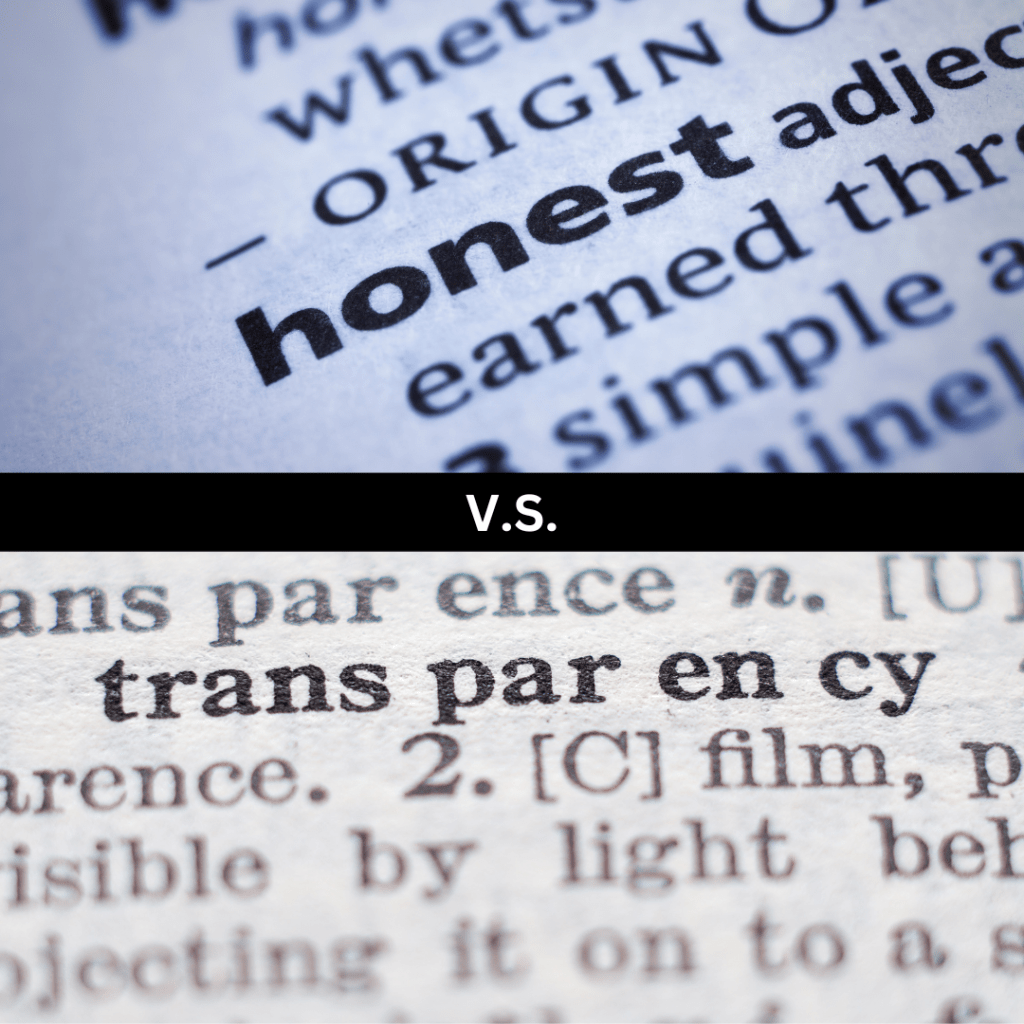
Inkrement #18: Honesty vs. Transparency

As I sat in my therapist’s cozy office, she asked a question that left me momentarily perplexed: “Do you want honesty or do you want transparency?” Having recently ended a long-term relationship, I had confidently asserted that honesty was at the top of my list of qualities I sought in a future partner. But in that moment, I realized that there might be more to it than I initially thought. Inspired by the guidance of my therapist, I embarked on a journey to understand the subtle yet significant differences between honesty and transparency.

Unveiling the Distinction:

To me, honesty and transparency always went hand in hand. What could be the difference between them when both had the same underlying principle of truth-telling? My therapist, with her characteristic wisdom, gently explained that while they indeed share common ground, they have distinct levels of truthfulness.

Honesty, as I learned, encompasses being truthful and straightforward when asked. It involves not intentionally deceiving or misleading others. When we demand honesty in a relationship, we expect our partner to speak the truth when confronted with a question or a situation. It means expressing our true feelings and thoughts without fabricating or sugarcoating them.

On the other hand, transparency goes beyond simply answering a question truthfully. It involves willingly offering relevant information without being prompted. Transparency requires laying one’s cards on the table, allowing our partner to make informed decisions based on the full picture. It’s about open communication, sharing intentions, and freely providing context.

The Playing Cards Analogy:

To illustrate the difference, my therapist used a clever analogy involving playing cards. She held a handful of cards, and when asked if she had the Queen of Hearts, she honestly admitted to having it, revealing the card as evidence. However, she emphasized that this information was only disclosed after being questioned.

In contrast, she explained that transparency is like laying all the cards on the table without prompt. She openly announced, “Hey, I have the Queen of Hearts, Ace of Spades, and 10 of Diamonds. You can decide how you want to move next.” By offering this information voluntarily, she allowed her partner to have a more thorough understanding of the situation and make decisions accordingly.

Building Trust and Understanding:

Understanding the subtle yet crucial distinction between honesty and transparency has truly blown my mind and transformed my perspective on relationships. I now realize that while honesty forms the foundation of trust, transparency strengthens and deepens it. Both qualities are vital in cultivating strong and healthy connections.

Honesty breeds trust by ensuring that our words align with our actions. It reassures our partner that they can rely on us to be truthful, even in difficult predicaments. However, it is transparency that provides the context and information necessary for our partner to truly understand us. It helps us avoid misunderstandings, enables empathy, and allows for better decision-making in the long run.

Striking the Balance:

I’ve learned that striking a balance between honesty and transparency is essential to building genuine, fulfilling relationships. Honesty sets the groundwork for trust, but transparency takes it a step further by promoting open and honest communication. By embracing transparency, we create an environment where vulnerability and understanding can flourish. We enable our partners to see us authentically, free from hidden agendas or undisclosed information. This creates an environment of mutual respect and sincerity, strengthening the emotional bond between two people.

My therapist’s insightful question unearthed a world of nuance that never dawned on me before. Honesty and transparency may seem interchangeable at first glance, but their distinction is vital in building healthy relationships. Honesty establishes trust, while transparency deepens understanding. Together, they provide a solid base for lasting connections.

I’ll carry my newfound understanding in my heart as I continue to move forward. Honesty and transparency are vital for my partner and I to build trust, understanding, and open communication on our journey together. In the words of Michelle Obama, “Whether you come from a council estate or a country estate, your success will be determined by your own confidence and fortitude.” May we all find the courage to pursue honesty and transparency, and may it lead us to the profound connections we deserve.

Posted in Blog, Mental Health, Personal, Reflections, Writing

Inkrement #16 – Simply the Best

The recent news of the passing of the legendary Rock & Roll icon, Tina Turner, at the age of 83 has deeply impacted music lovers across the world. As someone who has been influenced by her incredible talent and resilience throughout my life, I felt compelled to reflect on her remarkable journey. From the haunting melody of “What’s Love Got To Do With It?” that played in the background of my childhood to the powerful anthem “I Don’t Wanna Fight” that still resonates with me today, Tina Turner’s music has always been a constant presence.

Tina Turner was more than just an iconic singer and performer; she was a force to be reckoned with. Her ability to turn personal pain into something transcendent showcased her resilience and indomitable spirit. Despite enduring unspeakable challenges throughout her life, she refused to let her pain define her. Instead, she harnessed her anguish as a catalyst for personal transformation, inspiring millions around the world.

Tina Turner’s early memories of picking cotton as a child, coupled with feelings of abandonment and being unloved by her parents, painted a difficult picture of her formative years. Surviving a volatile and abusive relationship added to her burdens. Yet, throughout it all, Tina Turner’s resilience and determination to overcome prevailed. Her journey from these painful beginnings to becoming a middle-aged black woman who made her mark as the Queen of Rock & Roll is a testament to the human spirit’s capacity to rise above adversity.

One of the most inspiring aspects of Tina’s story for me is the love and fulfillment she found later in life. After facing numerous challenges and triumphing over personal struggles, she discovered peace and genuine love with someone who adored her unconditionally. This profound love story brought immeasurable joy and contentment to her life, proving that true greatness and contentment can be achieved at any stage. Tina Turner’s experience challenges the belief that success and happiness must be attained within certain age limits or predetermined timelines. Her story encourages us to embrace the unexpected turns and twists that life presents. It’s okay if we haven’t achieved our dreams or found our purpose by a certain age. The path to self-discovery and fulfillment can be nonlinear, and each stage of life offers unique opportunities for growth and transformation. Tina’s life exemplifies the importance of perseverance, resilience, and remaining open to new possibilities.

Tina’s ability to turn her pain into something magical and beautiful continues to inspire many, including myself. It’s with this inspiration in mind that I started this blog. In time, I want to be able to provide solace, tools, and hope to those facing trauma. Tina’s legacy serves as a reminder of the need for diverse voices and stories of triumph over hardship. Together, we can build a resilient community founded on mutual support, where people can find strength and renewed hope as they navigate their own transformative journeys.

The world has lost an icon in Tina Turner, but her legacy will forever resonate through her music, her story, and the transformative power of her journey. As we remember her, let us carry her spirit of resilience, transformation, and unwavering pursuit of happiness with us. By embracing our own pain and using it as a catalyst for personal growth, we too can turn our lives into something magical and beautiful.

Rest in Power, Queen ❤

Posted in Blog, Creative Writing, Mental Health, Reflections, Writing, Writing Prompts

Inkrement #15 – Unplugging for Mental Wellness: My Digital Detox Journey to Self-Compassion

Writing prompt: Describe a self-care ritual that helps you combat self-criticism and fosters self-compassion. Write a step-by-step guide on how to engage in this ritual, highlighting its benefits for emotional well-being.
———————–

Today, I want to share a self-care ritual that helps me out when I feel my inner-critic starting to get the best of me. Picture this: a break from Instagram, Twitter, TikTok, and all other social media. An opportunity to rediscover yourself, and an opportunity to prioritize your mental well-being. For this entry, I’ll let you know the steps of my own digital detox journey, sharing the tips and lessons I learned along the way.

Step 1: Understand the Benefits of a Digital Detox

First things first, let’s clarify what a digital detox is all about. It’s a conscious decision to disconnect from the digital realm, particularly social media platforms, for a specified period. It’s a chance to step away from the constant comparison, pressure, and noise of the online world. But why is it needed for our mental health? Constant exposure to social media can trigger self-criticism, feelings of inadequacy, and a distorted sense of reality. Stepping away allows us to take back our time, regain a sense of balance, and care for ourselves.

Step 2: Acknowledge the Need for Change

For me, the journey started with admitting the toll social media was taking on my mental health. I noticed the inner-critic growing louder, comparing my life to picture-perfect posts of my friends, wondering where I went wrong in my life, and questioning my own worth. It was time for change—a time to prioritize my well-being, to listen to my intuition, and to find a healthier way to engage with the digital world.

Step 3: Set Clear Intentions

Before hastily deactivating all your accounts, take a moment to set clear intentions. Reflect on what you hope to gain from this experience. Is it a desire to cultivate self-compassion, regain a lease on life, or reconnect with your hobbies? Set your goals and keep them in mind as you get started.

Step 4: Decide Your Detox Timeframe

Figure out how long you want to step away from social media. It could be a few days, a week, or even longer. Trust your instincts and choose a timeframe that feels right for you. Keep in mind that this is your path, and there is no need to follow strict guidelines. Give yourself the liberty to experiment and figure out what works best for you.

Step 5: Communicate Your Detox

Let your loved ones and close friends know about your digital detox plans. Communicate your intentions, explain the purpose behind it, and ask for their support. Letting them know will reduce any feelings of guilt or FOMO (fear of missing out) and immerse yourself without distractions.

Step 6: Prepare for Temptations

Prepare yourself for potential temptations during your digital detox. Delete social media apps from your phone or mute notifications. Create a physical barrier between yourself and your devices, like keeping them in a different room or using a designated drawer. Creating boundaries will help you resist mindlessly scrolling and keep your detox on track.

Step 7: Explore Life Outside of the Screen

Step away from the screen and enjoy real-world experiences.. Reconnect with hobbies that ignite your passion and joy. Rediscover activities you’ve neglected or explore new ones that pique your interest. Dive into books, create art, practice mindfulness, engage in nature, cook new recipes, or go on a physical adventure. The options are endless! Allow yourself to be fully present in these real life moments. Enjoy connecting with yourself and the world.

Step 8: Practice Mindful Awareness

During your digital detox, take time to practice mindfulness. Tune into your thoughts and emotions, observing them without judgment. Notice the moments when self-criticism arises and shift your focus to self-compassion. Try different techniques like deep breathing exercises, meditation, or journaling to nurture that feeling of serenity and contemplation.

Step 9: Cultivate Self-Compassion

As you detach from the digital world, take this opportunity to practice being kinder to yourself. Embrace the imperfections and celebrate your unique journey. Challenge your inner-critic with kind and encouraging pep-talks. Remind yourself that your worth extends far beyond the curated world of social media. Embrace self-acceptance, celebrate your accomplishments (big and small), and foster a loving relationship with yourself.

Step 10: Reflect and Integrate

When your digital detox comes to an end, take time to reflect on the experience. Journal about the insights, emotions, and any transformations you’ve encountered along the way. Celebrate your growth and self-love. Acknowledge the lessons learned and consider how you can integrate the positive aspects of your detox into your everyday life moving forward.

By consciously unplugging from the digital world, you can take a significant step toward combating self-criticism and nurturing self-compassion. Through this particular self-care ritual, I learned the importance of signing off to reconnect with myself, finding joy in offline hobbies, and being present in the moment. This is something I try to do at least one weekend a month. Setting boundaries, taking care of ourselves and staying mindful can truly make a difference in one’s mental well-being and to foster self-compassion.
————————–

I chose this prompt for several reasons. My therapist has been drilling in my head that I need to practice more self-care and give myself more grace when it comes to life events. This prompt encouraged me to ritualize a way to take care of myself and my overthinking tendencies. Writing out all the steps encouraged my self-awareness and mindfulness. Explaining the “how” and “why” of taking social media breaks helped me comprehend their long-term benefits. I also hope that this gives someone an idea for how they can handle things when the self doubts and criticism start becoming too much.